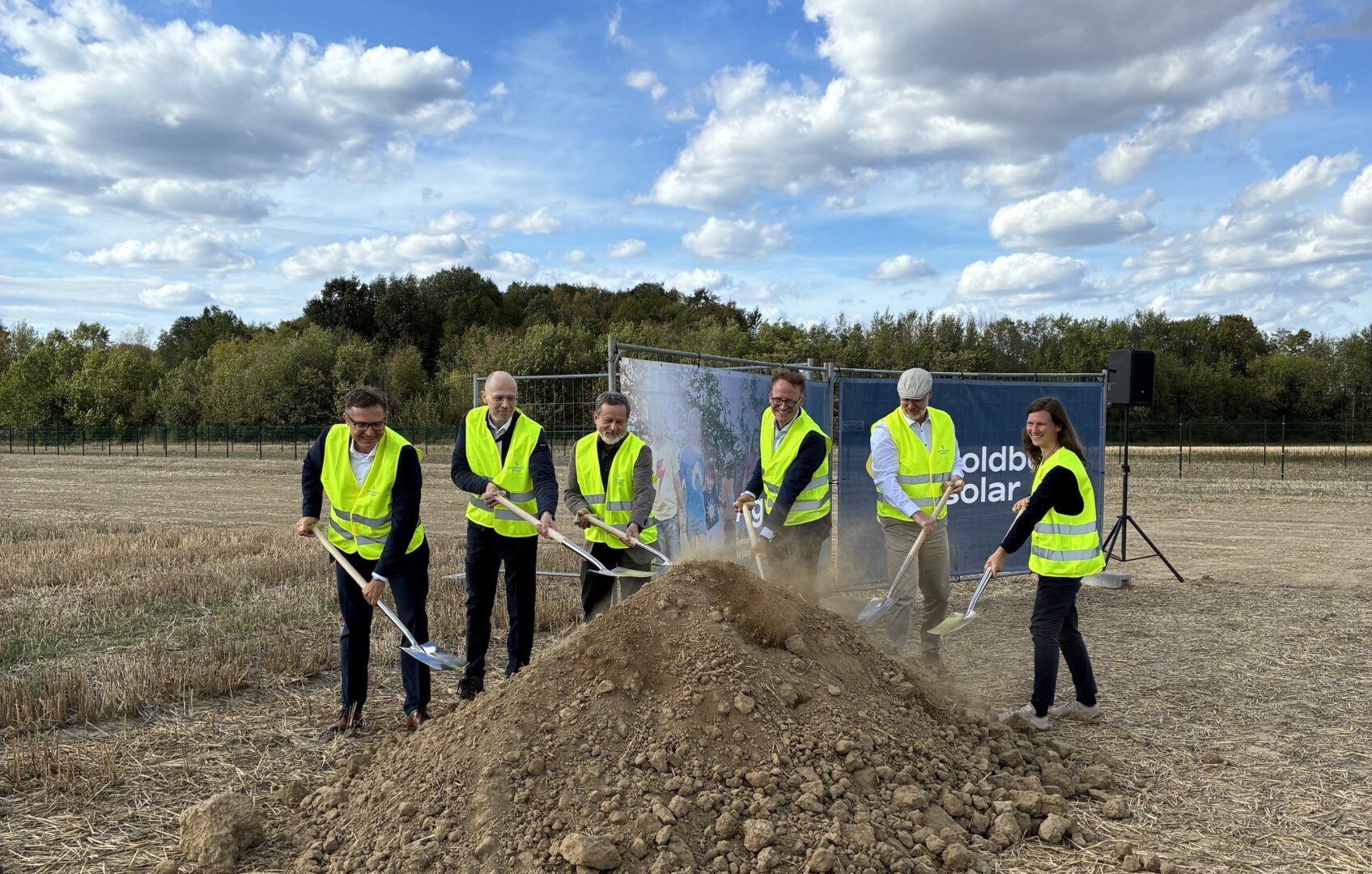
“With this project, we are creating an application-oriented Agri-PV park that demonstrates economies of scale under real-world conditions, while also serving as a permanent showroom for our customers. What is often on display for only a few days at trade shows, investors can experience here in operation all year round,” says Johannes Dewald, project manager at GOLDBECK SOLAR.
Innovative approaches are also being taken to finance the project. For example, the local energy cooperative Hohe Waid has an equal stake in the project and its financing. The cooperative, in turn, receives its funds from a broad spectrum of members who contribute varying amounts depending on their own wishes and preferences.
This ensures, to a large extent, that the people who can see the Agri-PV system can also benefit from it. The value created by the project remains in the local community, says Mathhias Schütze of the Hohe Waid eG energy cooperative. “With this financing model, we’re clearly embedding the project within the local community. This increases acceptance among local residents,” he adds.
Ralf Gänshirt, mayor of Hirschberg, says: “From the very beginning, the municipality of Hirschberg has worked in close collaboration with local government bodies and project developers. Everyone involved was committed to making the project a reality. The ‘Sonnenweg’ project is thus not only another groundbreaking step toward our sustainable energy supply, but also demonstrates innovative solutions for the parallel use of land for both solar power and agriculture.”
A Direct Comparison of Three Systems
A total of 7,982 solar modules will be installed on an area of approximately 10 hectares. What makes this project unique is that three different mounting systems will be compared under real-world operating conditions.
Two of the three installed systems are so-called tracker systems. These automatically align the solar modules with the sun’s position, thereby maximizing energy output. As a result, power generation is more closely aligned with the electricity market, forming the economic foundation of the overall project. In one system, two modules are arranged in portrait orientation, and in the other, one module is arranged in portrait orientation; both are combined with various agricultural applications. The third system is a fixed-tilt system with a vertical orientation, in which the modules are permanently installed and farming operations take place between the rows.
In addition, the Agri-PV project includes a reference area of approximately 2 ha for agricultural use located right next to it. This allows the Agri-PV systems to be directly compared with agricultural applications.
Agriculture remains an integral part
The land will continue to be used for agricultural purposes. The Agri-PV system is designed so that farming operations take place between and beneath the rows of modules. With tracker systems, it is possible to tilt the rows of modules upward. This allows tractors and other machinery to work the fields without any problems.
In addition to electricity generation, the research focuses in particular on the interaction between agriculture and photovoltaics. The facility is used to implement various technologies and agricultural applications simultaneously and provides insights for future Agri-PV projects.
Among other things, the study examines the following questions:
- Which crops are suitable?
- What agricultural machinery is used?
- What synergies can be created?
- How do the performance metrics of the various tracker and fixed-tilt systems evolve over the long term?
To answer these questions, extensive sensor and monitoring systems are installed to continuously collect and analyze data.
Permanent Showroom
With this innovative Agri-PV project, GOLDBECK SOLAR is creating a unique demonstration site for customers, investors, and the interested public. Visitors can use informational panels to directly compare the various systems and see how they work in actual operation.
“The facility is essentially an exhibition. Customers can see the technologies in real-world conditions instead of relying solely on technical data sheets,” explains Johannes Dewald.
Turnkey implementation from a single source
As a general contractor (EPC—Engineering, Procurement, and Construction), GOLDBECK SOLAR is responsible for the complete turnkey implementation of the plant. This includes the design and construction of all components:
- Solar Modules
- Mounting Structures
- Tracking and control systems
- Inverters
- Substation
- Grid Connection and transfer station
- Future integration of battery storage systems
The pilot plant is set to be further expanded in the future. A key focus will be on integrating battery storage systems to test the interaction between solar power generation, energy storage, and grid integration under real-world conditions.
With this versatile Agri-PV project, GOLDBECK SOLAR underscores its commitment to further developing innovative technologies in a practical manner and to actively shaping the future of sustainable energy supply.