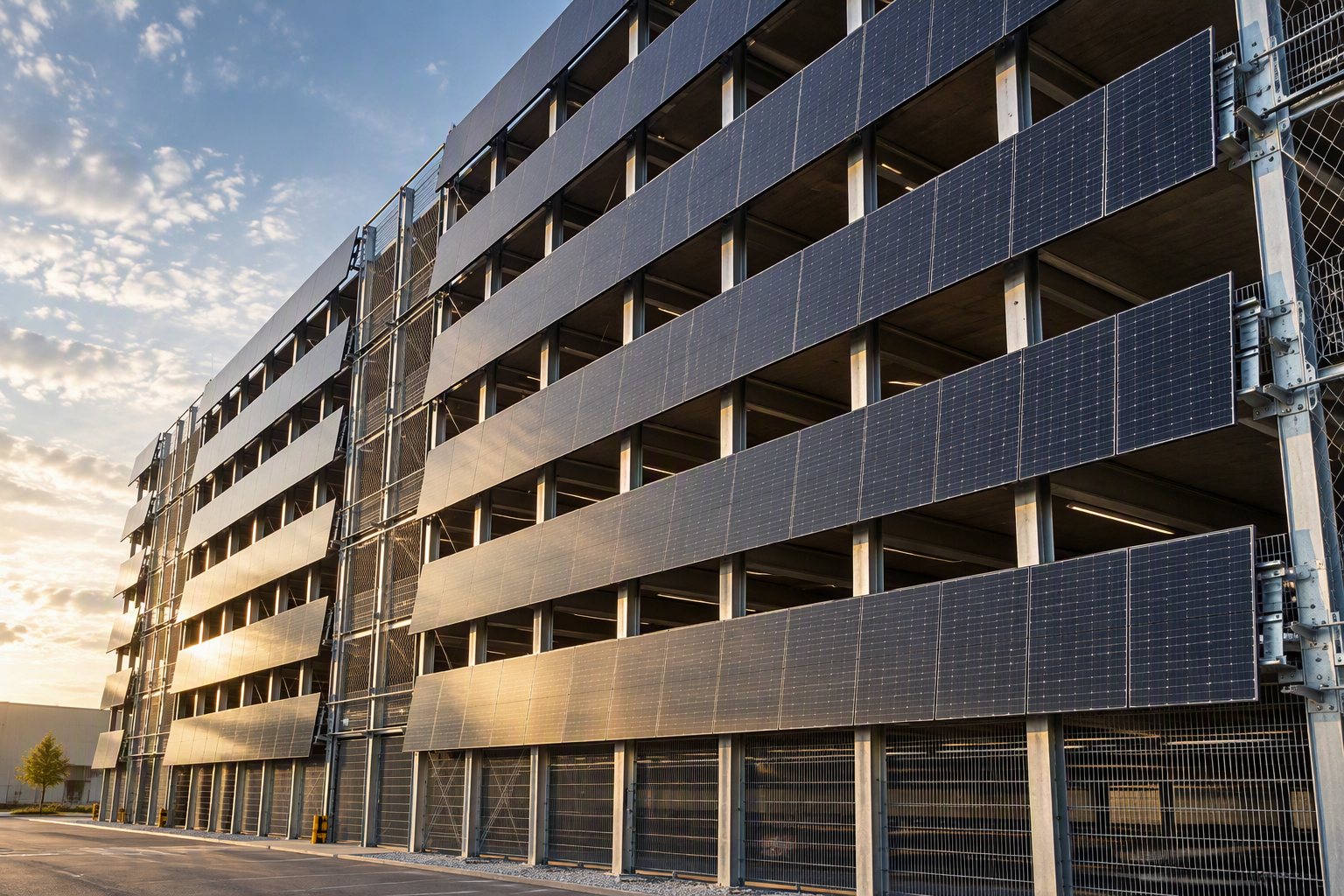
Solar Facades for Commercial and Industrial Use
The facades of commercial and industrial buildings offer great potential for local renewable energy generation. Instead of remaining a passive cost factor, the facade becomes an active component of the building and energy system.
Photovoltaic modules can replace conventional facade materials while generating electricity without requiring additional roof or open space. Module sizes, colors, and layouts can be tailored to the building’s architecture. This makes solar facades suitable for both selected facade areas and entire building envelopes.
01
Additional Solar Capacity
Expand solar power generation at your site if available roof space is limited, already in use, or insufficient.
02
Active Building Envelope
Combine the functional requirements for the facade with the generation of renewable electricity.
03
Architectural Integration
Combine the solar facade with rooftop photovoltaics, battery storage, charging infrastructure, and an energy management system.
04
Coordinated Technical Planning
Take structural, fire safety, and electrical engineering requirements into account in an integrated planning process.
05
Scalable Implementation
Implement solutions ranging from selected facade areas to complete photovoltaic building envelopes.
One building. Two functions.
Conventional facade materials protect and enhance the appearance of a building. A solar facade adds an additional function to the building envelope: the local generation of renewable electricity.
This dual-use approach is particularly relevant for commercial and industrial sites with growing energy needs and limited roof or open space. Solar facades combine weather protection, thermal and acoustic properties, and architectural design with the generation of renewable energy.
Additional Benefits
Dual Use of the Facade
One building component, two functions: Solar facades replace conventional facade materials while simultaneously generating renewable electricity without taking up additional space.
Supplementary Production Profile
Vertical surfaces facing east-west or south generate electricity, especially in the morning and evening. This complements the typical midday peak of rooftop photovoltaic systems.
Functional Building Envelope
Solar facades can combine electricity generation with protection against the weather, heat, noise, and sunlight. They are suitable for both warm and cold facades, up to the passive house standard.
Architectural Added Value
Colored and semi-transparent modules open up additional design possibilities for new construction, prestigious buildings, and existing properties.
ESG and Decarbonization
Generating electricity through the building envelope increases energy self-sufficiency, reduces CO₂ emissions, and supports taxonomy and ESG goals.
Economic Potential
According to the ISFH source cited in the presentation, south-facing solar facades can be economically viable even without subsidies when combined with battery storage systems.
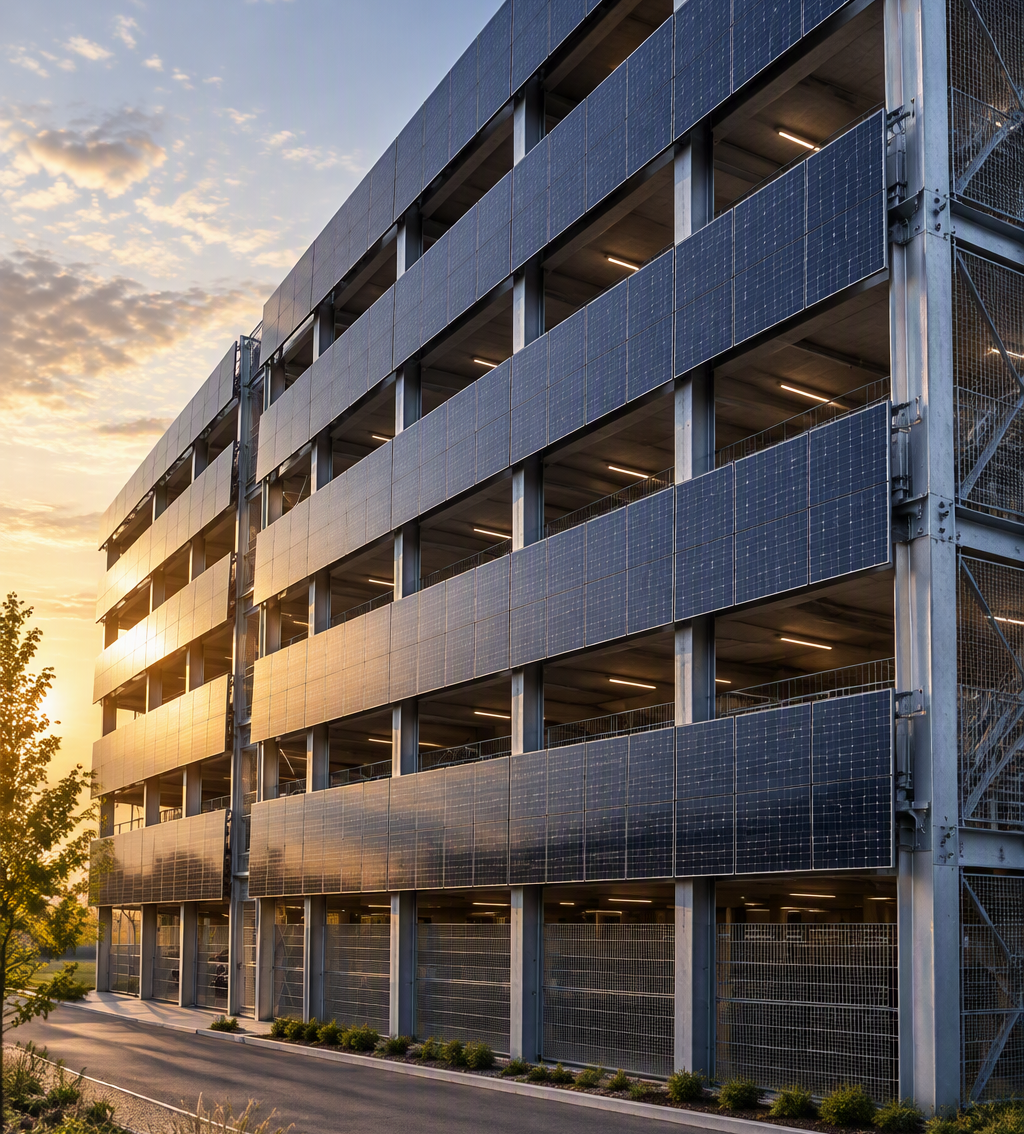
Untapped Space Potential
The building envelope offers a significant opportunity for the further expansion of photovoltaics in Germany
- 12,000 km² of theoretically usable facade area, roughly equivalent to twice the total roof area in Germany.
- Up to 320 GW of potential photovoltaic capacity on facade surfaces.
- Approximately 1,000 GWp of technical photovoltaic potential on buildings in Germany, including roof and facade areas.
- Approximately 400 GWp of photovoltaic capacity is needed by 2045 to achieve climate neutrality. Thus, utilizing the building envelope can make an important contribution
Using the Facade as an Energy Source
Every building requires a customized solution. The scalable approach illustrated in these facade designs ranges from individual facade sections to a complete photovoltaic building envelope. Our range of services includes concept development, consulting, coordinated technical planning, and construction implementation—all from a single source.
Solar facades can also be combined with rooftop photovoltaics, battery storage, solar carports, and charging infrastructure. Instead of planning each technology in isolation, they are integrated into a coordinated energy system.
Turn the building envelope into an active component of the energy system. Generate additional renewable electricity, use existing space more efficiently, and combine architectural functionality with long-term decarbonization.