The Merseburg battery park is a grid-connected energy storage system with 12 MW of power and 16 MWh of capacity. Realized as an EPC project for Blue Elephant Energy, the plant supports grid stability and uses the business case of arbitrage (time-delayed marketing of energy). The short distance to the grid connection point reduces the line length and associated losses and promotes efficient operation. It also creates know-how in the storage sector and serves as a reference project for further BESS investments.
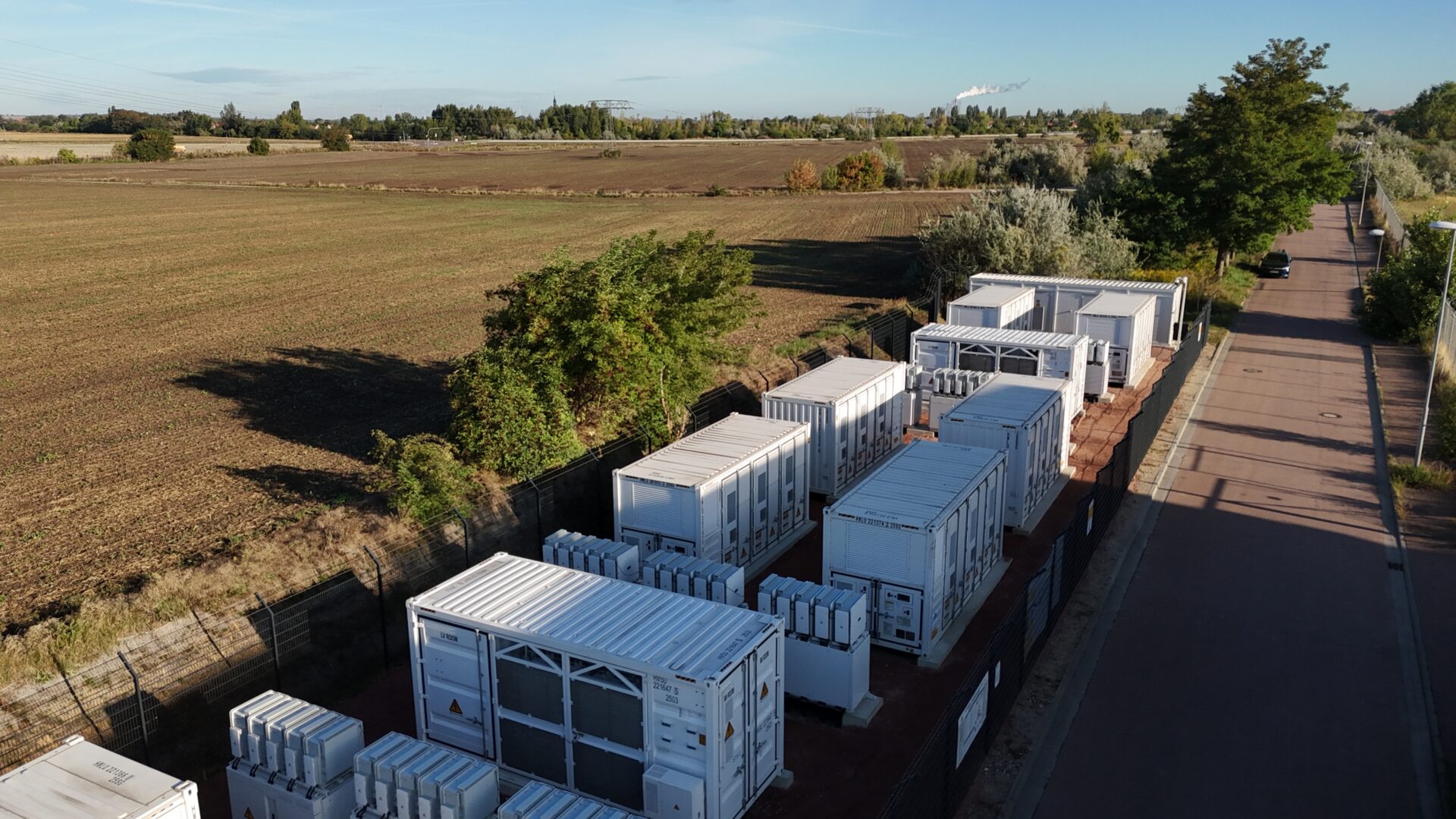
Battery Park Merseburg
Key Facts
- Type: Gridscale battery storage system (BESS)
- Output / capacity: 12MW / 16 MWh
- Use: grid stability (system services) and arbitrage
- Location advantage: short distance to the grid connection point
- Construction time/IBN: ~1.2 years
Project objective and application scenarios
The storage facility is used to provide system-relevant services (e.g. frequency regulation) and for arbitrage trading. In this case, electricity is stored in the grid when there is an oversupply and made available in times of increased demand.
Technical concept and location
The system is designed for fast response and high availability. The short distance to the grid connection point simplifies the connection, reduces infrastructure costs and supports economical continuous operation. As EPC, GOLDBECK SOLAR is responsible for the planning, construction coordination and implementation of the project as well as quality control & HSE through to commissioning.
Benefits and classification
The location strengthens local grid stability and enables market-oriented management of local consumers.
Classification of the effects
The following key figures are for guidance only, as battery storage systems do not generate their own energy yield, but can store electricity and make it available again at different times:
CO₂ effect (assumption): With one cycle per day and a simplified reference value of 1 kg CO₂ per kWh – based on a fossil electricity mix – this results in an indicative saving of around 5,475 t CO₂ per year.
Household consumption (assumption): Based on an average daily consumption of approx. 6 kWh, the storage system could mathematically supply around 2,500 households with energy for one day. In practice, however, the capacity is used to shift electricity over time and to stabilize the grid, not to provide a continuous supply.
About our customer Blue Elephant Energy GmbH:
Blue Elephant Energy develops, acquires and operates solar and wind parks (onshore) as well as battery storage solutions with a focus on the European market. Since its foundation in 2016, BEE has established itself as a leading independent power producer (IPP).